Use our free Pearson age calculator below to instantly find your exact age in years, months, weeks, and days.
Pearson Chronological Age Calculator
Enter the date of birth and test date to calculate exact chronological age in years, months, and days.
Chronological Age Result
What Is a Pearson Age Calculator?
A Pearson age calculator is a tool that goes beyond simply counting how many years you’ve lived. It calculates your precise chronological age and maps it to a recognized stage of human development.
Unlike a standard age calculator, a Pearson-based tool gives you meaningful context: not just how old you are, but where you are in the human lifespan and what psychological and physical milestones typically define that period.
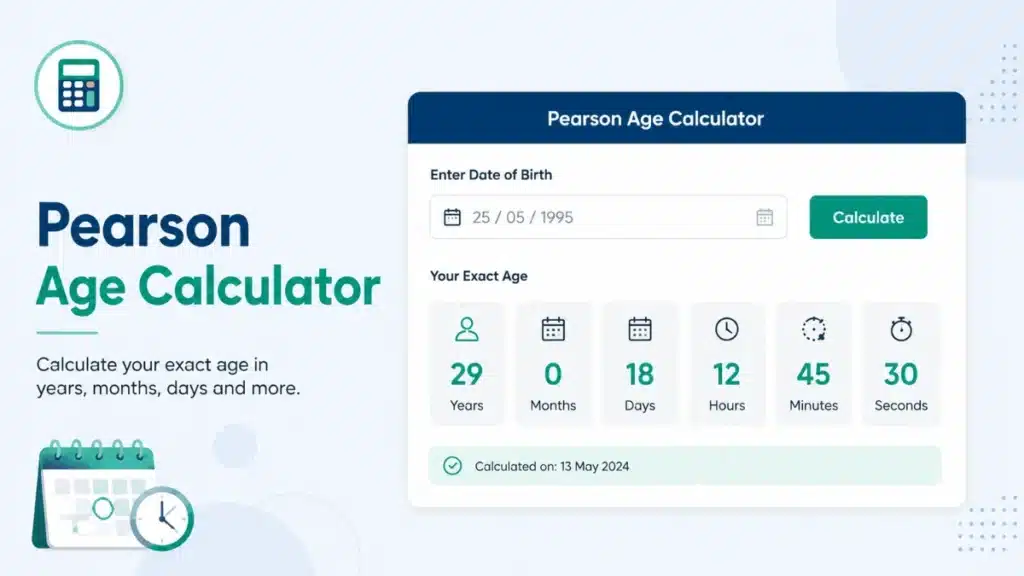
How to Use This Pearson Age Calculator
Using the calculator is straightforward:
- Select your date of birth using the Day, Month, and Year dropdowns.
- Choose your test date either today’s date (default) or a custom date in the past or future.
- Click “Calculate Age” to instantly see your results.
How Age Is Calculated: The Method Behind the Tool
This calculator uses precise calendar-based arithmetic, not a simple year subtraction. Here’s how it works:
- Your date of birth is subtracted from the reference date (today or your chosen date).
- The calculator accounts for varying month lengths, leap years, and exact day counts.
- The result gives you an exact age, for example, 34 years, 7 months, and 12 days, rather than just a rounded number.
Example Calculation
Let’s look at a simple example:
- Date of Birth: January 1, 2000
- Calculation Date: January 1, 2025
The results will look something like that:
- Exact Age: 25 years, 0 months, 0 days
- Age in Months: 300 months
- Age in Weeks: ~1304 weeks
- Age in Days: ~9,125 days
- Age in Hours: ~219,000 hours
- Age in Minutes: ~13,140,000 minutes
- Next Birthday: January 1, 2026
- Days Until Birthday: 365 days
Chronological Age vs. Biological Age vs. Psychological Age
While this calculator measures chronological age (time since birth), it’s worth understanding how this differs from related concepts:
| Age Type | Definition | Measured By |
|---|---|---|
| Chronological Age | Time elapsed since birth | Calendar calculation |
| Biological Age | How old do you feel and think you are | Biomarkers, telomere length, epigenetics |
| Psychological Age | How do your roles and responsibilities compare to peers | Self-report, cognitive assessments |
| Social Age | How do your roles and responsibilities compare to those of your peers | Life stage assessments |
Pearson-style developmental frameworks primarily work from chronological age as a baseline, while acknowledging that individuals vary significantly within any given stage.
Read: Chronological Age vs Biological Age: What’s the Difference?
Frequently Asked Questions
1. How accurate is this Pearson age calculator?
Very accurate. The calculator uses calendar-precise arithmetic that accounts for varying month lengths and leap years. It calculates your age down to the exact day.
2. Which generation do I belong to based on my birth year?
Generational cohorts are broadly defined as:
Baby Boomers: 1946–1964
Generation X: 1965–1980
Millennials (Gen Y): 1981–1996
Generation Z: 1997–2012
Generation Alpha: 2013–present
3. Is this calculator suitable for children?
Yes. The calculator works for ages from birth onward and includes information on infant and early childhood developmental stages.
Tips for Using Age Calculations in Real Life
Understanding your exact age and developmental stage has practical applications beyond curiosity:
- Healthcare: Many health screenings are recommended at specific ages (e.g., colonoscopy at 45, mammogram at 40–50). Knowing your exact age helps you stay on schedule.
- Legal and financial planning: Pension eligibility, retirement accounts, and legal thresholds are often age-specific to the day.
- Educational assessments: School placement, gifted programs, and learning disability evaluations frequently reference chronological age for norm-referenced scoring.
- Personal reflection: Understanding which developmental stage you’re in can provide a meaningful framework for thinking about life goals, relationships, and personal growth.
Our Other Age-Related Tools!

I’m the creator of Calculators Ocean, dedicated to building easy-to-use, reliable tools that simplify everyday calculations. Passionate about numbers, logic, and practical problem-solving, I design each calculator to save time and help people make smarter decisions.