Learning how to read tarot cards opens the door to self-discovery, intuition development, and spiritual guidance. While tarot may seem intimidating at first with its 78 cards and rich symbolism, this comprehensive beginner’s guide will walk you through everything you need to know to start reading tarot cards confidently and accurately.
Related: Tarot Birth Card Calculator
What Are Tarot Cards?
Tarot cards are a powerful divination tool consisting of 78 cards divided into two main sections: the Major Arcana and Minor Arcana. Originally used as playing cards in the 15th century in Italy, it then evolved into a system for spiritual guidance and self-reflection by the 18th century.
Today, tarot reading isn’t about predicting a fixed future… it’s about gaining insight into your present circumstances, understanding patterns in your life, and exploring possibilities based on your current path. Think of tarot as a mirror reflecting your inner wisdom and a tool for accessing your intuition.
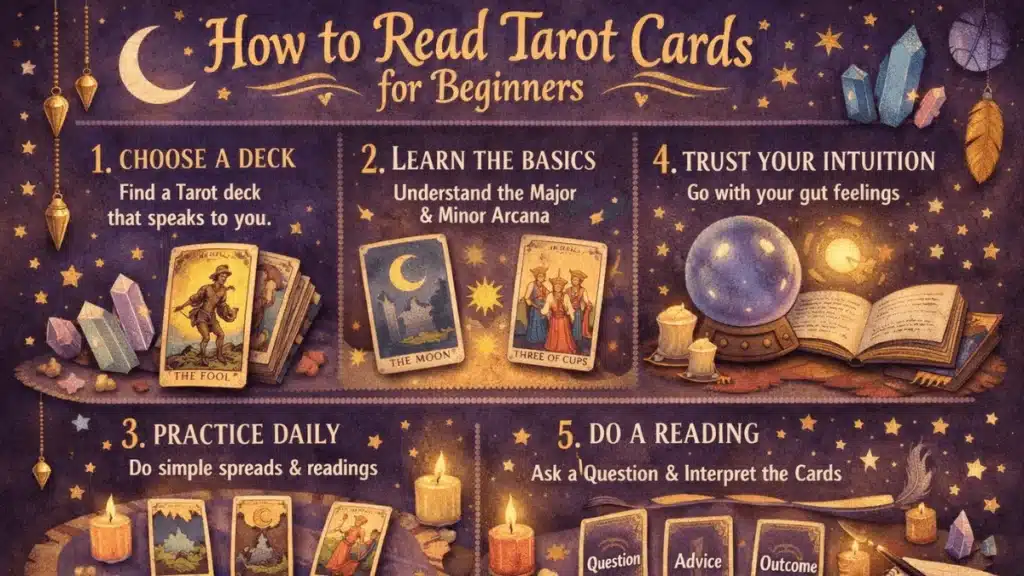
Understanding the Tarot Deck Structure
Before you begin reading tarot cards, it’s essential to understand the deck’s structure and how the cards work together.
The Major Arcana (22 Cards)
The Major Arcana represents life’s significant lessons, spiritual themes, and pivotal events. These 22 cards, numbered 0 through 21, tell the story known as “The Fool’s Journey,” which is a symbolic path from innocence to enlightenment that mirrors human spiritual evolution.
Major Arcana Cards Include:
- The Fool (0) – New beginnings, potential, innocence
- The Magician (1) – Manifestation, power, resourcefulness
- The High Priestess (2) – Intuition, mystery, inner knowledge
- The Empress (3) – Fertility, nurturing, abundance
- The Emperor (4) – Authority, structure, stability
- The Hierophant (5) – Tradition, spiritual guidance, conformity
- The Lovers (6) – Love, relationships, choices
- The Chariot (7) – Willpower, determination, victory
- Strength (8) – Courage, inner strength, compassion
- The Hermit (9) – Introspection, solitude, inner guidance
- Wheel of Fortune (10) – Cycles, fate, turning points
- Justice (11) – Fairness, truth, cause and effect
- The Hanged Man (12) – Surrender, new perspective, letting go
- Death (13) – Endings, transformation, rebirth
- Temperance (14) – Balance, moderation, patience
- The Devil (15) – Bondage, materialism, temptation
- The Tower (16) – Sudden change, upheaval, revelation
- The Star (17) – Hope, inspiration, renewal
- The Moon (18) – Illusion, intuition, subconscious
- The Sun (19) – Joy, success, vitality
- Judgement (20) – Rebirth, reckoning, inner calling
- The World (21) – Completion, achievement, wholeness
When Major Arcana cards appear in readings, they indicate significant life themes, spiritual lessons, or major turning points that deserve special attention.
The Minor Arcana (56 Cards)
The Minor Arcana represents daily life, practical matters, and the smaller events that shape our everyday experiences. These 56 cards are divided into four suits, each containing 14 cards: Ace through Ten (numbered cards) plus four Court Cards (Page, Knight, Queen, King).
The Four Suits and Their Meanings:
Wands (Fire Element)
- Represents: Passion, creativity, energy, action, ambition, inspiration
- Life area: Career, projects, goals, personal drive
- Energy: Active, dynamic, bold
- Keywords: Motivation, willpower, instinct, growth
Cups (Water Element)
- Represents: Emotions, relationships, intuition, feelings, creativity
- Life area: Love, friendships, emotional well-being, artistic pursuits
- Energy: Flowing, emotional, receptive
- Keywords: Love, compassion, imagination, connection
Swords (Air Element)
- Represents: Thoughts, communication, intellect, truth, conflict
- Life area: Mental processes, decisions, challenges, clarity
- Energy: Sharp, analytical, cutting
- Keywords: Logic, judgment, communication, truth
Pentacles/Coins (Earth Element)
- Represents: Material world, finances, physical body, practical matters
- Life area: Money, career, health, material possessions, security
- Energy: Grounded, stable, tangible
- Keywords: Abundance, manifestation, work, security
Court Cards (Page, Knight, Queen, King) represent personality types, actual people in your life, or aspects of yourself. They can indicate:
- Pages: Youth, new learning, messages, beginning stages
- Knights: Action, movement, pursuit of goals, adolescence
- Queens: Mature feminine energy, mastery, nurturing approach
- Kings: Mature masculine energy, authority, leadership, mastery
Choosing Your First Tarot Deck
Selecting the right tarot deck is an important first step in your tarot journey. While tradition suggests you should be gifted your first deck, this is simply a myth; buying your own deck is perfectly acceptable and often necessary to start your practice.
Best Tarot Decks for Beginners
Rider-Waite-Smith Tarot (RWS): This is the most recommended deck for beginners and the most widely used tarot deck worldwide. Created in 1909 by artist Pamela Colman Smith under the direction of Arthur Edward Waite.
Why It’s Perfect for Beginners:
- Rich, detailed imagery tells a story on each card
- Most tarot books and resources reference this deck
- The illustrations contain the symbolism you need to understand the cards
- Widely available and affordable
Other Beginner-Friendly Options:
- Modern Witch Tarot: Contemporary diverse imagery with RWS foundation
- Everyday Tarot: Minimalist, easy-to-read designs
- Luminous Spirit Tarot: Beautiful artwork maintaining traditional symbolism
- Wild Unknown Tarot: Nature-based imagery for intuitive readers
What to Look For:
- Illustrated pip cards (numbered Minor Arcana cards with scenes, not just symbols)
- Imagery that resonates with you personally
- Clear, distinguishable artwork
- A guidebook included for reference
- Standard card size (too large or small can be difficult to shuffle)
Trust your intuition when choosing a deck. If a deck speaks to you visually and emotionally, that connection will enhance your readings.
Essential Tarot Reading Basics for Beginners
Setting Up Your Reading Space
Creating the right environment enhances your connection to the cards and your intuition.
Prepare Your Space:
- Find a quiet, comfortable area where you won’t be disturbed
- Clear the surface where you’ll lay out cards
- Consider lighting a candle or incense if that helps you focus
- Have your tarot journal and guidebook nearby
- Silence your phone and minimize distractions
- Set an intention or say a brief opening statement
Clearing Your Deck’s Energy: Some readers like to clear their deck’s energy before reading, especially when first acquiring it or after someone else has touched it. Methods include:
- Knocking on the deck three times
- Visualizing white light surrounding the cards
- Holding the deck and setting an intention
- Leaving cards in the moonlight overnight
- Using smoke from sage or incense (though not necessary)
How to Shuffle Tarot Cards
There’s no single “correct” way to shuffle tarot cards. Find what feels comfortable and natural to you.
Common Shuffling Methods:
- Overhand Shuffle: Traditional card shuffling technique
- Mixing Method: Spread the cards face down on the table and mix them around
- Cutting the Deck: Split the deck into piles and restack
- Intuitive Shuffle: Shuffle until it “feels right” to stop
How Long to Shuffle: Shuffle while focusing on your question or intention. Stop when you feel ready… this might be after a few seconds or a few minutes. Many readers shuffle until a card jumps out or they feel an intuitive pull to stop.
About Reversed Cards: Some beginners read all cards upright (called “dignities”), while others incorporate reversed cards (upside-down cards with modified meanings). As a beginner, you can choose to:
- Read all cards upright initially to simplify learning
- Add reversals once comfortable with upright meanings
- Pay attention if a reversed card jumps out during shuffling
Pulling Cards: Trust Your Intuition
When it’s time to select cards for your reading:
Fan Method: Spread cards in an arc, hover your hand 2-3 inches above them, and pull cards where you feel drawn (heat, tingling, magnetic pull)
Top Card Method: Simply pull cards from the top of the shuffled deck
Cut and Pull: Cut the deck into sections and pull from different piles
Jumper Cards: If a card falls out while shuffling, consider it a message to include in your reading
The key is trusting your intuition. Your subconscious will guide you to the cards meant for you.
Daily Tarot Practice: The One-Card Pull
The absolute best way to learn tarot as a beginner is through daily practice with a single-card pull. This simple exercise builds your connection with the cards, develops intuition, and helps you learn meanings organically.
How to Do a Daily Card Pull
Morning Ritual:
- Shuffle your deck while thinking about the day ahead
- Pull one card
- Study the imagery without looking at the guidebook first
- Notice your immediate emotional response
- Ask yourself: What do I see? How does this make me feel?
- Journal your initial impressions
- Check the guidebook for traditional meanings
- Carry the card’s lesson with you throughout the day
Evening Reflection:
- Review your morning card and notes
- Reflect on how the card’s energy appeared in your day
- Record specific events that are connected to the card’s meaning
- Notice patterns over time
This practice accomplishes multiple goals:
- Builds personal connections with each card
- Develops trust in your intuition
- Creates a reference library of your experiences
- Makes learning gradual and manageable (78 days to work through the full deck)
- Provides meditation and reflection practice
Reading Tarot Card Imagery Intuitively
One of the most powerful beginner techniques is learning to read the pictures on the cards rather than memorizing meanings. The Rider-Waite-Smith deck’s illustrated scenes contain everything you need.
How to Read Intuitively
Observe the Card Carefully:
- What’s happening in the scene?
- What are the figures doing?
- What’s the emotional tone?
- What symbols appear? (colors, objects, animals, numbers)
- What’s the setting? (indoors, outdoors, day, night)
- How do the figures interact?
Notice Your Emotional Response:
- Does the card feel positive, negative, or neutral?
- What emotions does it evoke?
- Does it remind you of anything personal?
- What’s your gut reaction?
Tell the Story: If you can see and describe what’s happening in the card, you can understand its meaning. For example:
- Three of Swords: Three swords pierce a heart under stormy clouds. The imagery clearly suggests heartbreak, pain, or emotional difficulty.
- Four of Cups: A figure sits under a tree, arms crossed, ignoring three cups while a hand offers a fourth. This suggests apathy, dissatisfaction, or missing opportunities.
- Ten of Pentacles: A multi-generational family stands before a grand estate with pentacles arranged abundantly. This clearly indicates wealth, legacy, family security, and material success.
Trust that the imagery will speak to you. Your intuition combined with visual observation is more powerful than rote memorization.
Simple Tarot Spreads for Beginners
Spreads are layouts that assign specific meanings to card positions, providing structure for your readings. Start simple and work your way up to more complex spreads.
1. One-Card Spread
Use for:
- Daily guidance
- Quick yes/no questions
- Getting a general energy reading
- Specific focused questions
How to use it: Simply pull one card after asking your question. This card represents the answer, energy, or guidance for your situation.
2. Three-Card Spread: Past-Present-Future
This is the most popular beginner spread and provides a complete story in three cards.
Card Positions:
- Card 1 (Left): Past – Influences that led to this situation
- Card 2 (Center): Present – Current situation or challenge
- Card 3 (Right): Future – Likely outcome based on current path
How to Read It: Look at how the cards flow together. Does the past explain the present? How does the present lead to the future? The future card shows the trajectory, not a fixed destiny—it reflects where things are heading if the current path continues.
Example Reading:
- Past: Five of Pentacles (hardship, financial struggle)
- Present: Eight of Pentacles (hard work, skill development)
- Future: Ace of Pentacles (new opportunity, financial improvement)
Interpretation: Past struggles motivated current hard work and skill-building, which will lead to a new opportunity or financial fresh start.
3. Three-Card Spread Variations for Beginners
The three-card format is incredibly versatile. Here are other ways to use it:
Situation-Action-Outcome
- Card 1: Current situation
- Card 2: Recommended action
- Card 3: Likely outcome
Mind-Body-Spirit Check-In
- Card 1: Mental state
- Card 2: Physical state
- Card 3: Spiritual state
Stop-Start-Continue
- Card 1: What to stop doing
- Card 2: What to start doing
- Card 3: What to continue doing
You-Other Person-Relationship
- Card 1: Your energy/perspective
- Card 2: Other person’s energy/perspective
- Card 3: The relationship dynamic
Challenge-Lesson-Growth
- Card 1: Current challenge
- Card 2: Lesson to learn
- Card 3: Growth opportunity
4. Five-Card Spread for Deeper Insight
Once comfortable with three cards, try a five-card spread:
Positions:
- Present Situation: Where you are now
- Challenge: Obstacle or difficulty
- Past Influence: Foundation affecting the situation
- Future Influence: What’s approaching
- Advice/Outcome: Guidance or potential result
Read the cards in order, then look at how they relate to each other to create a complete narrative.
How to Interpret Tarot Cards: Reading Tips for Beginners
Look at Multiple Cards Together
Individual cards gain deeper meaning when read in context with surrounding cards. Consider:
- Predominant suit: Many Cups suggest emotional matters; many Swords indicate mental challenges; many Wands point to action/passion; many Pentacles relate to practical/material concerns
- Reversed cards clustered: Multiple reversals may indicate blocked energy, internal focus, or resistance
- Major Arcana heavy: Significant life lessons or events beyond your control
- Court cards: Actual people influencing the situation or personality aspects to embody
Trust Your Intuition Over Guidebooks
While guidebooks provide traditional meanings, your intuition and personal connection to the cards matter more. If a card’s imagery speaks to you differently than the book says, trust your interpretation, especially in the context of your specific question.
Reading Process:
- Look at the card and notice your immediate reaction
- Describe what you see happening in the imagery
- Consider how it relates to your question
- Check the guidebook to expand understanding
- Synthesize your intuition with traditional meaning
Consider the Question Context
The same card means different things depending on the question:
- Three of Swords in a love reading: Heartbreak, betrayal
- Three of Swords in a career reading: Difficult news, office conflict
- Three of Swords in a health reading: Needing emotional healing to improve physical health
Always interpret cards through the lens of what you’re asking about.
Notice Patterns in Your Readings
- Recurring cards: If the same card appears repeatedly, pay special attention to its message
- Stalker cards: Cards that keep showing up indicate persistent themes needing attention
- Missing suits: If readings never show a particular suit, that life area may need development
- Number patterns: Seeing many of the same numbers (all threes, all fives) has significance
Don’t Fear “Negative” Cards
There are no inherently bad cards in tarot. Cards like Death, The Tower, or Ten of Swords may look scary but carry important messages:
- Death: Transformation, necessary endings, rebirth—rarely literal death
- The Tower: Sudden revelation, breaking down false foundations, liberation
- Ten of Swords: Rock bottom means the only way is up; the end of difficulty
Every card has lessons and opportunities within it. “Difficult” cards often bring needed wake-up calls or breakthroughs.
Common Beginner Mistakes to Avoid
Don’t Try to Memorize All 78 Cards Immediately
This overwhelming approach causes frustration and burnout. Instead:
- Learn through daily practice
- Focus on understanding patterns (suits, numbers, court card roles)
- Let meanings develop organically through experience
- Reference guidebooks as needed without pressure to memorize
Don’t Read Intoxicated or in Poor Mental State
Tarot requires clear energy and boundaries. Reading while under the influence of alcohol or drugs creates:
- Difficulty maintaining proper energetic boundaries
- Inaccurate interpretations
- Potential for attracting unwanted energies
- Poor judgment in delivering messages
Avoid Reading for Skeptics Initially
As a beginner, build confidence through practice with supportive friends who are genuinely interested. Save the skeptics for when you’re more experienced and confident in your abilities.
Don’t Perform Readings Without a Clear Intention
Vague questions produce vague answers. Instead of “Tell me about my future,” ask:
- “What do I need to know about my career transition?”
- “How can I improve my relationship with [person]?”
- “What’s blocking me from reaching my goal?”
- “What energy should I focus on today?”
Don’t Give Your Power Away to the Cards
Remember that tarot provides guidance, not commands. You always have free will. The cards show trajectories and possibilities, but your choices shape outcomes. If you receive guidance you don’t resonate with, you’re free to take a different path.
Don’t Neglect Self-Care Around Tarot
Reading for yourself and others can be emotionally draining. Practice:
- Taking breaks between readings
- Clearing your energy afterward
- Protecting your emotional boundaries
- Not over-reading (obsessively asking the same question repeatedly)
- Respecting when you need rest
Understanding Reversed Tarot Cards
A reversed card appears upside-down in your reading. Not all readers use reversals; you can choose whether to incorporate them.
Meanings of Reversed Cards
Reversed cards typically indicate:
- Blocked or diminished energy: The card’s energy is present but restricted
- Internal focus: The meaning is happening internally rather than externally
- Opposite meaning: The inverse of the upright interpretation
- Resistance: You’re resisting the lesson or energy
- Delays: The upright meaning will manifest but timing is off
- Excess or deficiency: Too much or too little of the card’s energy
Should Beginners Use Reversals?
Arguments for waiting:
- Simplifies initial learning
- Reduces overwhelm
- Let’s you master upright meanings first
- 78 upright meanings provide plenty of nuance
Arguments for starting with reversals:
- Doubles your vocabulary immediately
- Adds complexity and accuracy
- Becomes harder to integrate later
- Natural part of card shuffling
Recommendation: Start with upright readings for your first 1-3 months, then experiment with reversals once you're comfortable with basic meanings. Trust your intuition about when to incorporate them.
Ethics of Reading Tarot for Others
When you begin reading for friends and family, remember these ethical guidelines:
Get Permission
Always ask before reading for someone. Unsolicited readings can feel invasive or uncomfortable.
Maintain Confidentiality
What’s shared in a reading stays private unless permission is granted to discuss it.
Be Honest But Compassionate
Deliver difficult messages with kindness and focus on empowerment. Frame challenges as opportunities for growth.
Know Your Limits
Don’t provide medical, legal, or financial advice unless you’re a qualified professional in those fields. Tarot offers guidance, not professional expertise.
Respect Free Will
Emphasize that the person has choices and power over their future. Avoid fatalistic predictions.
Value Your Skill
Even as a beginner, your time and energy have value. It’s appropriate to receive some form of exchange, whether that’s money, trade, or reciprocal services, though practice readings for friends learning together are fine.
Don’t Read When Emotionally Invested
Avoid reading in situations where you’re too personally involved to remain objective. For example, don’t read about a friend’s relationship with your ex-partner.
Developing Your Tarot Reading Skills
1. Practice Consistently
Like any skill, tarot improves with regular practice. Aim for:
- Daily one-card pulls
- Weekly three-card spread for yourself
- Monthly practice readings for willing friends
- Quarterly review of your journal to notice patterns
2. Study Card Combinations
As you advance, learn how cards modify each other’s meanings:
- Ace of Cups + The Lovers = New romantic relationship
- Five of Pentacles + The Star = Hope after hardship
- The Tower + Death = Complete transformation, major change
- Three of Swords + Temperance = Healing from heartbreak
3. Explore Different Spreads
Don’t limit yourself to one spread. Try new layouts regularly to understand how different structures provide different types of information.
4. Join Tarot Communities
Connect with other learners and experienced readers:
- Online forums and social media groups
- Local metaphysical shops often host tarot meetups
- Virtual tarot circles and workshops
- Instagram tarot community for daily inspiration
5. Read Tarot Books
Expand your knowledge with quality tarot literature. Some beginner-friendly recommendations:
- “78 Degrees of Wisdom” by Rachel Pollack – Comprehensive classic
- “The Ultimate Guide to Tarot” by Liz Dean – Excellent beginner reference
- “Tarot for Change” by Jessica Dore – Psychological approach
- “Holistic Tarot” by Benebell Wen – In-depth comprehensive guide
6. Explore the Symbolism
Deepen understanding by studying:
- Color meanings in cards
- Numerology (card numbers’ significance)
- Astrology (zodiac associations)
- Elemental correspondences
- Kabbalah connections (for advanced study)
7. Trust Your Development Timeline
Everyone learns at their own pace. Some people read confidently within weeks; others need months or years. Both paths are valid. Focus on your personal growth rather than comparing yourself to others.
Frequently Asked Questions
How long does it take to learn tarot?
Basic learning comes within 3-6 months of regular practice. However, tarot is a lifelong learning journey; even experienced readers continue discovering new layers of meaning.
Can I read tarot for myself?
Absolutely! Self-reading is one of the most valuable uses of tarot. Just be aware that strong emotions about a situation can cloud objectivity.
How often should I do readings?
Daily one-card pulls are beneficial. For larger spreads, be mindful not to obsessively re-read the same question. Give situations time to unfold before pulling cards again on the same topic.
Final Words!
Tarot is both an art and a practice. The cards themselves are simply illustrated cardstock; your intuition, intention, and wisdom bring them to life. As you develop your relationship with tarot, you’ll discover it’s not about the cards predicting your future but about you accessing your own inner knowing.
The most important step is simply beginning. Pull your first card today, study its imagery, feel its energy, and start your journey into the profound world of tarot. Your intuition has been waiting for you to listen; tarot provides the language for that conversation.

I’m the creator of Calculators Ocean, dedicated to building easy-to-use, reliable tools that simplify everyday calculations. Passionate about numbers, logic, and practical problem-solving, I design each calculator to save time and help people make smarter decisions.