You’ve probably met someone who’s 60 and looks and moves like they’re 45. Or maybe you know a 35-year-old who already seems worn down in ways that don’t quite match their years.
That disconnect isn’t just luck or genetics.
It comes down to the chronological age vs biological age, and understanding the two might just change how you think about your health entirely.
What Is Chronological Age?
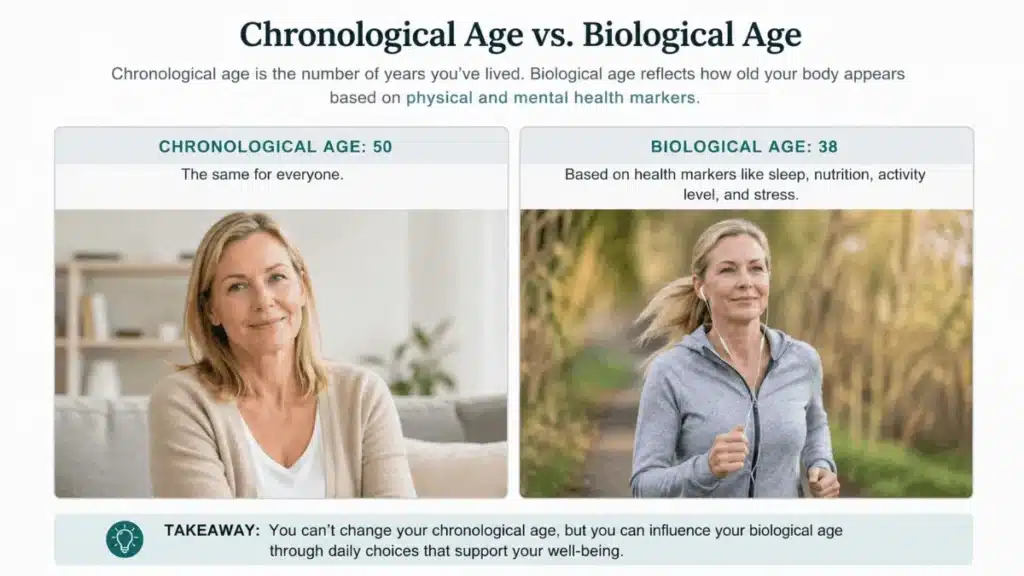
Chronological age is simple: it’s how long you’ve been alive. Count the years from your date of birth to today, and that’s it. No mystery, no nuance, just a number that ticks forward at the same rate for every single person on the planet.
While chronological age is useful for legal purposes (voting, retirement, driving), it tells us surprisingly little about how well your body is actually functioning.
Two people born in the same year can have radically different health profiles, disease risks, and life expectancies. Chronological age doesn’t account for any of that.
Related: Chronological Age Calculator (Find Out Your Age)
What Is Biological Age?
Biological age, sometimes called physiological age, is a measure of how old your body actually is at a cellular and molecular level. It reflects how well (or how poorly) your tissues, organs, and systems are holding up over time.
Unlike chronological age, biological age can go faster or slower depending on a whole range of factors: your lifestyle, your stress levels, your diet, your sleep, your environment, and yes, your genetics too (though genetics plays less of a role than most people think).
Here’s the key point: your biological age can be younger than your chronological age, or older. And it can change. That’s where things get genuinely interesting.
How Is Biological Age Measured?
This is one area where science has made real leaps in recent years. Researchers now have several ways to estimate biological age, and none of them involve guessing based on how many wrinkles you have.
Here is how it is measured:
1. Epigenetic Clocks
The most talked-about method right now is DNA methylation analysis, often called an epigenetic clock. As we age, tiny chemical tags on our DNA (called methyl groups) change in predictable patterns. Scientists can read these patterns and calculate a “methylation age”, a biological age estimate that’s proven remarkably accurate in research.
The most well-known versions are the Horvath clock and the GrimAge clock, both developed from large population studies.
GrimAge in particular has been linked to actual health outcomes and mortality risk, not just age estimation.
2. Telomere Length
Telomeres are the protective caps at the ends of your chromosomes; think of them like the plastic tips on shoelaces. Every time a cell divides, these caps get a little shorter. Shorter telomeres are generally associated with cellular aging and higher disease risk.
Telomere testing is commercially available, though it’s worth noting that telomere length is just one piece of the puzzle and has more variability than epigenetic methods.
3. Biomarker Panels
Some clinicians assess biological age through a combination of blood markers, things like inflammation levels (CRP), blood glucose, lipid profiles, kidney function, and cardiovascular indicators.
While no single marker tells the full story, patterns across multiple biomarkers can paint a meaningful picture.
4. Phenotypic Age
Developed by researchers at the National Institute on Aging, PhenoAge uses a combination of routine blood test results to estimate biological age.
It’s been validated in large studies and is one of the more accessible approaches for everyday clinical use.
Chronological Age vs Biological Age: The Key Differences
| Chronological Age | Biological Age | |
|---|---|---|
| Definition | Years since birth | Cellular/physiological condition |
| Changes | Fixed, increases by 1 each year | Variable – can increase or decrease |
| Influenced by | Nothing (it just passes) | Lifestyle, environment, stress, diet, sleep |
| Measurable? | Yes, exactly | Yes, through various biomarkers |
| Predictive of health? | Weakly | Much more strongly |
What Accelerates Biological Aging?
Certain lifestyle and environmental factors are well-documented to accelerate the biological aging of your body.
Some of the biggest culprits include:
- Chronic stress
- Poor sleep
- Processed food and excess sugar
- Sedentary lifestyle
- Smoking
- Heavy alcohol consumption
- Social isolation
What Can Slow (or Even Reverse) Biological Aging?
Here’s the genuinely exciting part. Unlike chronological age, biological age responds to your actions.
The research on this is still evolving, but several interventions have shown real promise. They include:
- Exercise
- Proper Sleep (6-8h)
- Caloric Restriction and Time-Restricted Eating
- Whole-Food, Anti-Inflammatory Diet
- Stress Management
- Cold and Heat Exposure
The Bottom Line!
Chronological age is just a timestamp. It tells you how long you’ve existed, not how well you’re aging.
Biological age, on the other hand, is the more honest and more actionable number, and unlike the date on your birth certificate, it’s something you actually have some control over.

I’m the creator of Calculators Ocean, dedicated to building easy-to-use, reliable tools that simplify everyday calculations. Passionate about numbers, logic, and practical problem-solving, I design each calculator to save time and help people make smarter decisions.