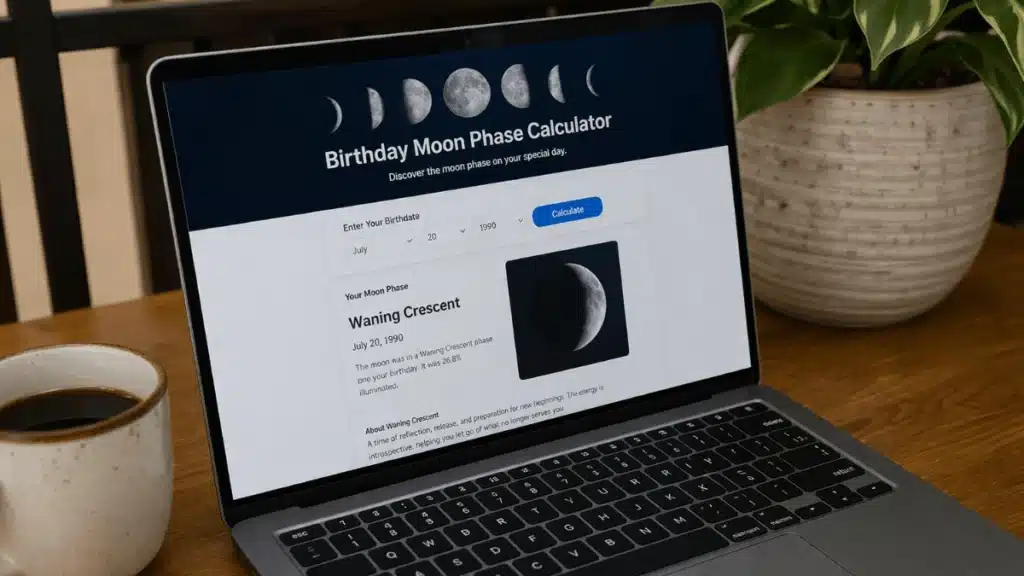
Have you ever wondered what the sky looked like on the night you came into the world? Use our free birthday moon phase calculator to find out instantly.
Just enter your date of birth and discover exactly which lunar phase lit the sky the moment you took your first breath.
Birthday Moon Phase Calculator
Discover the lunar phase on the night you were born
(days)
ation
Direction
Full Moon
—
You May Like to Know: How Rare Your Birthday Is
What Is a Moon Phase?
The moon doesn’t produce its own light; it reflects sunlight. As the moon orbits Earth over the course of roughly 29.5 days, the angle between the sun, Earth, and moon constantly changes. That changing angle determines how much of the sunlit side of the moon we can see from Earth. We call each stage of that 29.5-day journey a lunar phase.
There are eight distinct phases in every lunar cycle:
| Moon Phase | Description |
|---|---|
| New Moon | The moon is between Earth and the sun. The near side is completely unlit. The sky is at its darkest. |
| Waxing Crescent | A thin sliver of light appears on the right side. The moon is beginning to grow. |
| First Quarter | Exactly half the moon is illuminated. The cycle is one-quarter complete. |
| Waxing Gibbous | More than half is lit, but the Full Moon hasn’t arrived yet. Energy is building. |
| Full Moon | The moon is opposite the sun. The entire near side glows. The night is at its brightest. |
| Waning Gibbous | Just past full, the moon begins to shrink on the left side. |
| Last Quarter | Again, half is illuminated but this time the left side is lit as the moon shrinks. |
| Waning Crescent | A thin crescent remains on the left. The cycle is nearly complete. |
After the Waning Crescent, a New Moon begins again and the whole cycle repeats.
How Does the Birthday Moon Phase Calculator Work?
Our calculator uses a precise astronomical formula called the Julian Date method. The same approach is used by professional astronomers to determine the exact age of the moon on any given date.
Here’s how it works behind the scenes:
Step 1: Convert your birthday to a Julian Date.
The Julian Date is a continuous count of days since a fixed reference point in 4713 BC.
It allows us to calculate the exact number of days between any two dates in history, regardless of which calendar was in use.
Step 2: Calculate the lunar age.
We know that a well-documented New Moon occurred on January 6, 2000 at 18:14 UTC.
By finding the difference between your birthday and that reference date, then dividing by the length of a synodic month (29.53058867 days) and taking the remainder, we get the precise lunar age on your birth date, measured in days from the most recent New Moon.
Step 3: Determine the phase.
Based on the lunar age, the calculator identifies which of the eight phases the moon was in, calculates the illumination percentage, and determines whether the moon was waxing (growing) or waning (shrinking).
Step 4: Draw the moon.
The visual moon illustration is rendered on an HTML canvas using the actual mathematics of the phase, not a stock image. So what you see accurately represents the shape of the moon as it would have appeared.
Note: The result is accurate for any date from 1900 to the present day.
How to Find Your Moon Phase Without a Calculator
If you want to understand the calculation behind the tool, here’s the simplified version:
- Find the date of a known New Moon. January 6, 2000 is a reliable reference.
- Count the days between that New Moon and your birthday. This requires knowing the Julian Date of both.
- Divide by 29.53 (the length of the synodic month) and take the remainder. This is your lunar age in days.
- Match your lunar age to a phase:
- 0–1.85 days → New Moon
- 1.85–7.38 days → Waxing Crescent
- 7.38–9.22 days → First Quarter
- 9.22–14.77 days → Waxing Gibbous
- 14.77–16.61 days → Full Moon
- 16.61–22.15 days → Waning Gibbous
- 22.15–23.99 days → Last Quarter
- 23.99–29.53 days → Waning Crescent
For most people, this is exactly why calculators exist. Use the tool above.
Frequently Asked Questions
How accurate is this birthday moon phase calculator?
Very accurate. The calculator uses the Julian Date method with a known New Moon reference point (January 6, 2000), which is the same approach used in professional astronomical software.
What is the rarest moon phase to be born under?
All eight phases occur with roughly equal frequency, each one spans about 3–4 days of the 29.5-day cycle. However, the New Moon and Full Moon phases are the narrowest windows (about 1.8 days each), making them slightly less common birthdays.
Can the moon phase really affect my personality?
There is no scientific evidence that your birth moon phase determines personality. However, the symbolic traditions associated with each phase are rich, ancient, and cross-cultural. Many people find them useful as tools for reflection and self-understanding, much like astrology, numerology, or personality typing frameworks.
What’s the difference between waxing and waning?
Waxing means the illuminated portion is growing, the moon is moving from New toward Full. Waning means it’s shrinking, moving from Full back toward New.
Share Your Moon Phase
Once you’ve discovered your moon phase using the birthday moon phase calculator, why not share it? Copy your result using the button in the calculator and share it with friends and family.
Understanding the moon phase on your birthday is a small but surprisingly profound act of connecting to the universe you were born into. The same moon that has guided fishermen, farmers, navigators, poets and lovers for 200,000 years of human history was in a specific, unrepeatable position on the night you arrived.
Calculations are based on the Julian Date method using a verified New Moon reference date of January 6, 2000. Accurate for dates from 1900 to the present. Moon phase symbolism and personality descriptions are based on traditional lunar folklore and are intended for reflective and entertainment purposes only.

I’m the creator of Calculators Ocean, dedicated to building easy-to-use, reliable tools that simplify everyday calculations. Passionate about numbers, logic, and practical problem-solving, I design each calculator to save time and help people make smarter decisions.