Birthdays are universal celebrations but some hold a deeper, more personal touch than others. Among the most meaningful are the Golden Birthday, the Platinum Birthday, and the Diamond Birthday.
Whether you’re celebrating your own or planning an unforgettable event for someone you love, understanding what makes these birthdays so significant is the first step to marking them in a truly memorable way.
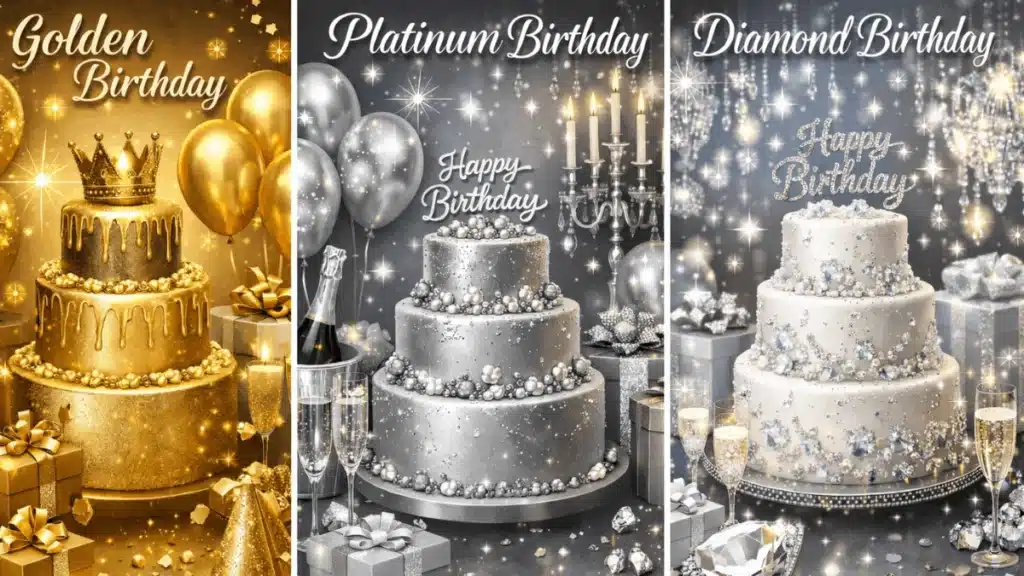
What Is a Golden Birthday?
A Golden Birthday, also called a “Lucky Birthday” or “Star Birthday”, occurs when a person turns the age that matches their birth date.
For example, if you were born on the 7th of any month, your Golden Birthday falls when you turn 7 years old. Born on the 25th? Your Golden Birthday is your 25th.
This alignment of day and age happens only once in a lifetime, which makes it a unique and exciting occasion.
The Origin of the Golden Birthday
The concept of the Golden Birthday is credited to Joan Bramsch, an American author and parenting advocate who coined the term in the 1950s.
She used the idea to make each of her five children feel uniquely special on their once-in-a-lifetime birthday match.
The tradition spread through word of mouth and has since become a widely recognized celebration across North America and beyond.
Golden Birthday by Birth Date: Quick Reference
Your Golden Birthday age is simply your birth day as a number:
- Born on the 1st → Golden Birthday at age 1
- Born on the 10th → Golden Birthday at age 10
- Born on the 18th → Golden Birthday at age 18
- Born on the 21st → Golden Birthday at age 21
- Born on the 31st → Golden Birthday at age 31
How to Celebrate a Golden Birthday
The number “gold” is the natural theme here. Popular celebration ideas include:
- Decorating with gold balloons, streamers and tablecloths
- Giving gifts equal to the person’s Golden Birthday age (e.g., 21 gifts for a 21st Golden Birthday)
- Hosting a “Golden Hour” party at sunset
- Planning a trip to a destination that the birthday person has always dreamed of
- Commissioning custom gold jewelry or a personalized keepsake
What Is a Platinum Birthday?
The Platinum Birthday is celebrated when the age matches the last 2 digits of your birth year.
So, let’s say, you were born in 1993, then your platinum birthday would be when you turn 93 years old.
Why Platinum Birthday?
Platinum is one of the rarest and most valuable metals in the world, even rarer than gold.
As a metaphor, it perfectly represents a birthday that surpasses the already extraordinary Golden Birthday, a celebration of longevity, resilience and a life richly lived.
How to Celebrate a Platinum Birthday
- A sophisticated evening event with platinum and silver decor
- A meaningful piece of platinum jewelry, e.g., a ring, bracelet, or necklace
- A curated experience, such as a private dinner, wine tasting, or weekend retreat
- A personalized photo book or memory album celebrating the journey so far
What Is a Diamond Birthday?
The Diamond and Platinum Birthdays are often used interchangeably as it is also celebrated when your age matches the last two digits of your birth year.
However, the diamond version tends to add a little extra shine, diamond-inspired elements and a sparkle-filled celebration.
The Symbolism of Diamonds
Diamonds are formed under immense pressure over billions of years, making them a fitting symbol for a person who has endured life’s challenges, embraced its joys and emerged with clarity and strength.
A Diamond Birthday is not just a number. It is a testament to a life of depth, brilliance and endurance.
How to Celebrate a Diamond Birthday
- An elegant black-tie dinner surrounded by close family and lifelong friends
- A diamond or crystal-themed gift, like jewelry, a crystal vase, a custom keepsake
- A tribute video or memory book featuring messages from people whose lives they have touched
- A charitable donation in the honoree’s name, reflecting their values and legacy
- A meaningful journey, returning to a beloved destination or fulfilling a lifelong travel dream
Frequently Asked Questions
What if you were born on the 29th, 30th, or 31st?
Your Golden Birthday falls later in life, at 29, 30, or 31 years old. This actually makes it more special, as it becomes an adult celebration with the capacity for more elaborate, meaningful planning.
Can you celebrate a Golden Birthday late?
Absolutely. Many people discover the concept of the Golden Birthday after the date has passed. A “belated” Golden Birthday celebration is entirely valid and can be just as joyful. Some people even celebrate the year of their Golden Birthday, not just the exact date.
Is the Platinum Birthday the same as the Golden Birthday in some cultures?
No. A golden birthday is celebrated when age matches the day you were born, while a platinum birthday means turning the same age as the last two digits of your birth year.
Are these birthday types officially recognized?
These are cultural traditions rather than officially recognized. Their meaning comes from personal and community significance, not any formal institution.
What is beyond the Diamond Birthday?
Some enthusiasts have proposed additional tiers, such as an “Emeralds Birthday” or age-specific milestones like 80th or 100th birthdays, each with its own gem symbolism. However, none of these carry the same established cultural recognition as Golden, Platinum, or Diamond Birthdays.
Final Thoughts
The Golden, Platinum and Diamond Birthdays are more than just numerical coincidences. They are cultural touchstones that invite us to pause, reflect and celebrate the extraordinary within the ordinary passage of time.
Each milestone carries its own beauty: the Golden Birthday captures the magic of childhood and youth, the Platinum Birthday honors resilience and growth into adulthood and the Diamond Birthday stands as a shining tribute to a long, well-lived life.

I’m the creator of Calculators Ocean, dedicated to building easy-to-use, reliable tools that simplify everyday calculations. Passionate about numbers, logic, and practical problem-solving, I design each calculator to save time and help people make smarter decisions.